Not every VHS tape behaves the same in a VCR. Two tapes recorded in the same decade can produce completely different results during digitization — especially when one was recorded in SP and the other in EP/SLP.
At Austin Video Solutions, this comes up often with family tapes, long event recordings, sports, school programs, and camcorder dubs. A tape may look reasonably stable for a few minutes, then develop tracking noise, horizontal tearing, picture loss, or unstable color. Sometimes the first question is whether the tape is damaged. Sometimes it is. But just as often, the recording mode and playback deck are a major part of the equation.
SP, LP, and EP/SLP: What Changed?
NTSC VHS recorders commonly offered multiple recording speeds. SP recorded at the fastest standard tape speed and usually produced the most robust picture. LP used less tape per minute. EP/SLP used even less, allowing a T-120 cassette to hold roughly six hours instead of two.
That extra recording time came with a trade-off: less tape surface was used for each moment of video. The recorded tracks are narrower, the effective bandwidth is lower, and the recording becomes more sensitive to alignment differences between the machine that recorded the tape and the machine playing it back years later.
| Recording mode | Typical T-120 capacity | Digitization behavior |
|---|---|---|
| SP | About 2 hours | Usually the most forgiving and stable |
| LP | About 4 hours | More sensitive to tracking and deck alignment |
| EP / SLP | About 6 hours | Most sensitive to tracking, head condition, and machine-to-machine differences |
Why One VCR Can Play a Tape Better Than Another
VHS is an analog mechanical format. Playback quality depends on the physical tape path, head alignment, tracking system, head wear, tension, electronics, and the exact way the original recorder laid down the signal.
That is why a difficult tape is not always judged from a single machine. A tape that produces heavy noise in one deck may track more cleanly in another. Professional Sony and Panasonic decks, well-maintained consumer decks, and certain camcorder transports can each behave differently with a marginal recording.
For EP/SLP material, that machine-to-machine difference can be dramatic because the recorded tracks are narrower. Small alignment differences that barely matter on a clean SP recording may become visible as tracking noise or instability on a six-hour tape.
What Professional Playback Can — and Cannot — Fix
Professional playback is not magic restoration. It cannot recreate detail that was never recorded, and it cannot fully repair severe oxide loss, physical creases, broken tape, or information that is simply missing from the magnetic recording.
What the right workflow can do is avoid adding unnecessary problems during capture. At AVS, a difficult tape may involve:
- testing more than one appropriate playback deck when tracking is unstable;
- manual tracking adjustment when automatic tracking does not lock correctly;
- basic tape-path or shell inspection when the cassette is not transporting normally;
- time-base correction or signal stabilization where appropriate;
- monitoring picture stability and audio during the capture rather than assuming the first playback is good enough;
- capturing interlaced NTSC correctly and preparing a smooth progressive viewing file for modern displays.
Why Rewinding or Replaying Can Sometimes Change the Picture
Customers are sometimes surprised when an old tape behaves differently after a full rewind, fast-forward, or another playback pass. That can happen because tape tension, pack, friction, and the way the cassette is sitting on the reels can change slightly. A marginal cassette can therefore appear temporarily better or worse without the underlying recording having changed.
This is one reason AVS does not assume that one brief playback tells the whole story. If a tape is important and the first result looks abnormal, the workflow can be adjusted before deciding that the problem is permanently baked into the recording.
EP/SLP Does Not Mean the Tape Is Hopeless
Many valuable family recordings were intentionally made in EP/SLP because people wanted birthdays, graduations, sports games, weddings, school events, or television appearances to fit on one cassette. Those recordings are often softer and noisier than SP recordings, but they can still digitize well enough to be preserved, watched, edited, and shared.
The important point is that the playback stage matters. A six-hour VHS tape should not automatically be treated like a clean two-hour SP cassette. When the signal is difficult, deck choice and careful monitoring can make the difference between an avoidable playback problem and the best practical capture the tape can still provide.
What AVS Delivers After Capture
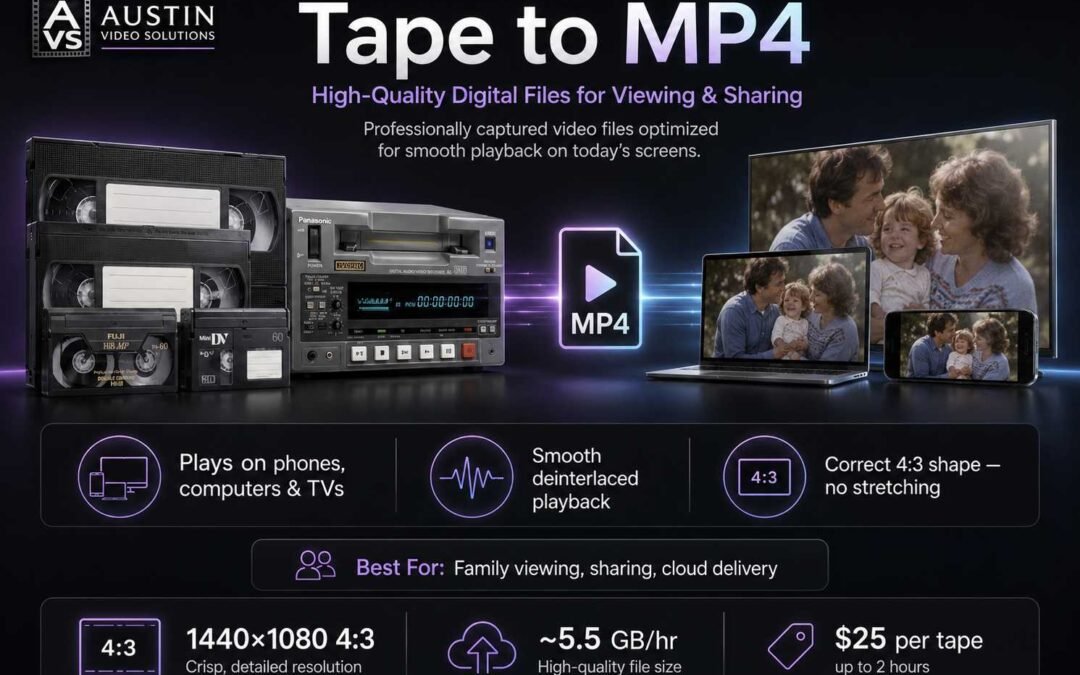
For standard Tape to MP4 service, Austin Video Solutions prepares VHS footage as a properly deinterlaced H.264 MP4 for modern screens while preserving the original 4:3 image geometry. The standard MP4 service is currently $25 per started 2-hour block. Editing-friendly ProRes and lossless master-file options are also available for documentary, restoration, and archival workflows.
If a tape has unusual tracking problems, unstable playback, physical damage, or another issue that requires extra work, that is discussed before advanced repair or restoration is added.
See the current VHS to MP4 service details, compare current transfer pricing, or book a South Austin drop-off appointment.